If you have spent any time around AI tooling in the last year, you have probably seen the letters MCP show up everywhere. It is in product launches, GitHub repos, conference talks, and the release notes of basically every serious AI company. So what is it, and why did it go from a niche announcement to something people treat as plumbing for the whole industry?
Here is the short version. MCP, the Model Context Protocol, is an open standard that lets AI models talk to your tools and data through one common interface. That is it. The reason it matters is that this one boring sounding idea quietly solves a problem that was eating enormous amounts of engineering time.
The problem nobody wants to keep solving
Think about what an AI model actually needs to be useful at work. It needs to read your documents, check your calendar, query your database, pull a customer record, post to a channel, open a ticket. A model on its own cannot do any of that. It only knows how to produce text. To make it useful, somebody has to build a connection between the model and each system it touches.
Before MCP, every one of those connections was custom. You wanted Claude to read from your database? Someone wrote glue code for that exact pairing. You wanted a different model to do the same thing? New glue code. You added a second database, a CRM, a file store? More glue code for each one. The math gets ugly fast. With a handful of models and a handful of tools, you end up maintaining dozens of fragile one off integrations that all break in slightly different ways.
This is the classic N times M problem. Every model has to be wired to every tool individually, and the total work grows with both numbers at once. It is the same mess the tech world has solved over and over with standards. USB did it for hardware. Language servers did it for code editors. MCP does it for AI.
How MCP actually works
The model is simple on purpose. There are three roles.
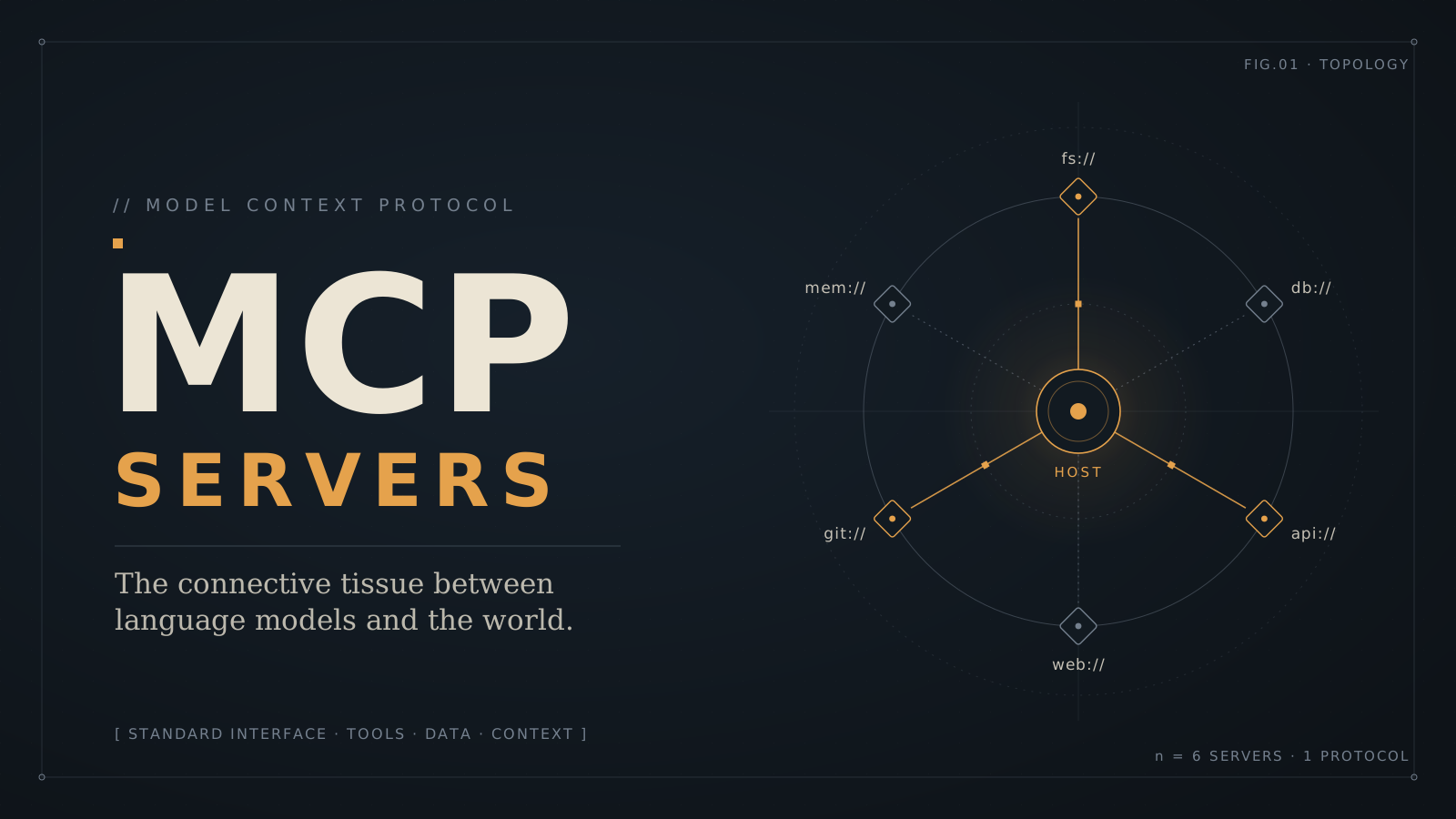
A host is the application the person is using. Claude, an AI coding assistant, a desktop chat app, something like that.
A client lives inside the host and manages the connection.
A server is the piece that wraps a specific tool or data source and exposes it in a standard way. A GitHub server, a Postgres server, a Slack server, a server for your own internal system.
Underneath, MCP uses JSON-RPC, which is a plain and well understood way for two programs to send each other structured messages. A server can offer three kinds of things to the model. It can offer tools, which are actions the model can take, like creating a record or running a search. It can offer resources, which are data the model can read, like files or rows from a table. And it can offer prompts, which are reusable templates for common tasks.
The clever part is discovery. The host does not need to know in advance what a server can do. It asks, and the server describes its own capabilities. That means you can plug in a new server and the model figures out what it can now do without anyone rewriting the host. Build a server once and any MCP compatible app can use it. Build a host once and it can talk to every server out there. The N times M problem turns into N plus M.
Why it caught on so fast
Anthropic released MCP as an open standard in November 2024, and the adoption curve has been steep. By March 2025 OpenAI had added support across its products including the ChatGPT desktop app, and Google DeepMind brought it into the Gemini world. Microsoft wired it into Copilot Studio and its developer tooling. By 2026 it was reaching tens of millions of SDK downloads a month and thousands of public servers existed for everything from developer tools to business apps.
A few things explain that speed.
It is genuinely open and vendor neutral. Anthropic built MCP but did not lock it to Anthropic products. That matters, because nobody wants to bet their integration strategy on a proprietary hook owned by one company. An open standard that a rival can adopt is a standard people trust.
It arrived right when it was needed. Agentic AI, meaning models that take actions rather than just answer questions, was becoming the main story. Agents are only as good as their access to real context and real tools. MCP showed up as the missing connective layer at the exact moment everyone hit that wall.
And it is simple enough to build against in an afternoon. Low friction standards win. Developers tried it, it worked, they shipped servers, and the ecosystem fed itself.
Why it matters for a business, not just engineers
It is easy to file MCP under developer trivia. That would be a mistake. The reason it matters at the strategy level is that it changes the economics of putting AI to work inside a company.
When integration is cheap and standardized, AI stops being a series of expensive bespoke projects and starts being something you can roll out across systems with far less custom work. You connect your tools once, in a standard way, and any model your team uses can reach them. That also means you are not married to a single AI vendor. If a better model comes along, your integrations come with you. Avoiding lock in is worth real money.
There is a governance upside too. Because MCP centralizes how models reach your systems, it gives you a natural place to put authentication, permissions, logging, and access controls. Instead of every integration handling security its own way, you get one layer to watch. For anyone who has to answer questions about what the AI can touch and who approved it, that is a meaningful improvement.
The honest caveats
It is not magic, and it is worth being clear about the rough edges.
Security is the big one. You are giving a model the ability to act on real systems through servers that someone wrote. A poorly built or malicious server is a real risk, and the standard is still maturing on how to vet and sandbox what runs. Treat MCP servers the way you would treat any third party code with access to your data, because that is what they are.
The ecosystem is also young. Quality across the thousands of available servers varies a lot. Some are excellent, some are weekend projects. Production use means you still have to pick carefully and often build your own for anything sensitive.
And standards are only useful while they stay coherent. So far the major players have aligned, which is the whole point. The thing to watch is whether that alignment holds as the protocol grows.
The bottom line
MCP is not a flashy idea. It is a connector, a common language between AI models and the systems they need to do real work. But connectors are exactly the kind of unglamorous infrastructure that ends up mattering most, because everything else gets built on top of them.
The simplest way to think about it is this. The last few years were about how smart the models could get. The next stretch is about how much they can actually do, and doing requires access. MCP is fast becoming the standard way that access happens. If agents are going to be useful inside real companies, something has to be the wire they run on. Right now, that something is MCP.