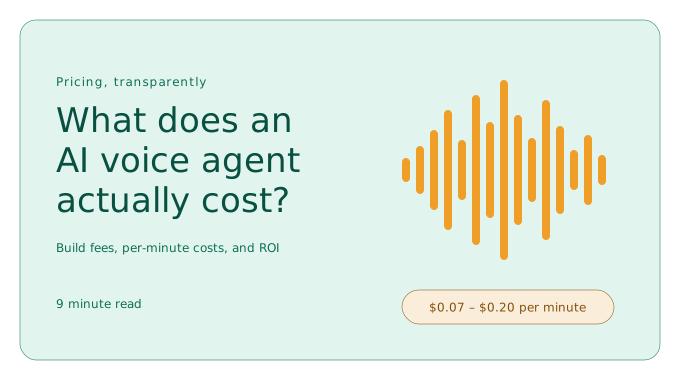
An AI voice agent has two separate costs. A one time build fee, typically between a few hundred and a few thousand dollars depending on how many systems it connects to, and a running cost charged per minute of call time, usually somewhere between seven and twenty cents. A business taking four hundred calls a month at three minutes each spends roughly one hundred to two hundred and forty dollars a month to run it.
Those are the numbers. The rest of this article explains where they come from, what makes them move, and how to work out whether the investment returns anything in your specific situation.
We publish our own pricing, which is unusual in this industry, so we may as well explain the reasoning behind it.
Why is voice agent pricing so hard to find?
Most agencies do not publish rates for one of two reasons. Either the price varies enormously by client and they do not want to anchor the conversation, or the price is high enough that publishing it would lose them the meeting.
There is a legitimate version of the first reason. A voice agent that answers a single question is genuinely a different product from one that qualifies leads across four languages and writes to three systems. Quoting one number for both would be misleading.
The illegitimate version is quoting based on what the client appears able to pay. You can usually detect this by asking what specifically drives the price up. If the answer is vague, the price is a guess about your budget.
The build cost
This is the one time cost of designing, connecting and testing the agent.
What you are actually paying for. Very little of it is the AI. The models are commodity infrastructure available to everyone at the same price. What takes the time is everything around them.
Conversation design, meaning deciding what the agent asks, in what order, and how it recovers when the caller gives an unexpected answer. Integration work, meaning connecting to your calendar, CRM, practice management system or order database, each of which has its own authentication and its own quirks. Escalation logic, meaning the rules for when the agent stops and passes the call to a person. And testing, which is the part that gets cut when a project is underpriced and is the reason underpriced projects fail.
What moves the price. In rough order of impact:
Number of systems being connected. One calendar is straightforward. A calendar plus a CRM plus a billing system means three integrations, three sets of credentials, and three failure modes to handle.
Number of distinct call types. An agent that only books appointments is one conversation. An agent that books, reschedules, cancels, answers pricing questions and takes complaints is five conversations sharing a phone line.
Languages. Each additional language needs its own testing pass, and accuracy varies by language and by accent within a language. This is not a copy and paste operation.
Outbound capability. Outbound calling introduces compliance considerations, retry logic, call windows and do not call handling that inbound does not require.
Regulatory context. Healthcare, finance and legal work carries requirements about recording storage, retention and which providers may process the audio. This has to be designed in, not added later.
Our own bands. For reference, our voice agent packages run at 250 dollars for a single inbound use case, 550 dollars for a multi use case agent with CRM integration, and 850 dollars for a multi language deployment including outbound. Complex or regulated builds are quoted separately because they genuinely are different work.
The running cost
This is the per minute cost, and it is charged by the underlying infrastructure providers rather than by the agency. It is worth understanding the components because it explains why the number varies.
Every minute of conversation consumes four things.
Telephony. The actual phone line, inbound or outbound. This is the smallest component and is fairly stable, roughly a cent or so per minute depending on country and number type.
Transcription. Converting caller audio to text continuously through the call. Priced per minute of audio processed.
The reasoning model. Priced per token, meaning per unit of text in and out. This is the component with the widest range, because a cheap fast model and a large capable model can differ by an order of magnitude. Most production agents use a fast model for the conversation and reserve a larger one for specific decisions.
Speech synthesis. Converting the reply back to audio. Priced per character generated. Higher quality voices cost more, and the difference is audible.
Added together, a typical production configuration in 2026 lands somewhere between seven and twenty cents per minute. The low end uses fast models and standard voices. The high end uses premium voices and heavier reasoning.
One thing that surprises people. Silence is not free. If your agent sits on the line while a caller thinks, you are still paying for the telephony leg and often for transcription. Well built agents handle this. Poorly built ones bleed money on hold time.
Costs people forget to budget for
Three categories account for most of the unpleasant surprises.
Phone numbers and routing. Dedicated numbers, call forwarding from your existing line, and any changes to your phone system. Small individually, but they exist.
Monitoring and review time. Someone on your team needs to read transcripts for the first month. This is not billable to a vendor but it is a real cost in hours, and skipping it is how a broken agent stays broken.
Ongoing maintenance. Your business changes. Prices change, services get discontinued, opening hours shift. An agent that is never updated will confidently quote information that stopped being true six months ago. Budget for a quarterly review, either internally or as a retainer.
Failed call handling. Calls the agent escalates still consume human time. If your agent escalates thirty percent of calls, you have reduced the human load by seventy percent, not eliminated it. Model this honestly.
How to work out whether it pays for itself
Most cost comparisons for voice agents are framed against a receptionist salary. That framing is usually wrong, because the agent does not replace a receptionist. It handles the calls the receptionist could not get to.
The more useful calculation has three inputs.
Input one: your monthly inbound call volume. Your phone provider can give you this. Most businesses guess low.
Input two: your missed call rate. This is the number that changes the conversation. Most service businesses have never measured it. When they do, it typically sits between twenty and forty percent, counting calls that ring out, calls that hit voicemail and are never returned, and calls arriving outside business hours.
Input three: the value of a converted enquiry. Not your average transaction. The lifetime value of a customer acquired through a phone enquiry.
The calculation. Take your monthly calls, multiply by your missed rate, multiply by whatever share of missed callers do not call back, then multiply by your enquiry conversion rate and the value of a customer. That gives you monthly revenue currently being lost on the phone.
A dental practice taking six hundred calls a month, missing twenty five percent, where half of those callers go elsewhere, converting one in three enquiries, at a patient lifetime value of eight hundred dollars, is losing in the region of twenty thousand dollars a month. Against that, a build fee in the hundreds and a running cost in the low hundreds is not a difficult decision.
A consultancy taking forty calls a month with a near zero miss rate has a completely different answer, and the honest recommendation there is to not buy a voice agent.
When the numbers do not work
It is worth being explicit about this, because vendors rarely are.
Low call volume. Below roughly one hundred calls a month, the operational benefit is real but the financial case is weak. You may still want it for after hours coverage, but do not expect it to pay for itself in saved time.
Highly variable calls. If every call is genuinely different and requires judgement, the agent will escalate most of them and you will have added a step rather than removed one.
High stakes first contact. Where the first ninety seconds of a call is itself the sale, and the person answering is a skilled closer, automating it destroys value rather than creating it.
No systems to connect to. If your bookings live in a paper diary, the agent cannot check availability. The integration is the point. Fix the underlying system first.
Comparing against the alternatives
Human answering service. Typically priced per call or per minute at a rate well above the running cost of an agent, and the service usually takes a message rather than completing the task. The comparison favours the agent on both cost and outcome, with the caveat that a good human service handles nuance better.
Part time receptionist. Covers a fixed window of hours. Costs the same whether they take five calls or fifty. The agent covers all hours and scales with volume. Most businesses that do this properly end up with both, where the agent handles overflow and after hours and the person handles the calls that need a person.
Doing nothing. This is the real competitor and it is rarely evaluated honestly, because the cost is invisible. Nobody sends you an invoice for the callers who rang out and went to a competitor.
Where to start
Before requesting a quote from anyone, get your three numbers. Monthly call volume, missed call rate, and value of a converted enquiry. Any vendor worth working with will ask for these anyway, and having them changes the conversation from a price negotiation into a return calculation.
If you want help working through those numbers against your own operation, or a fixed quote for a specific call type, get in touch and we will put something concrete in front of you.
Frequently asked questions
Is there a monthly minimum? It depends on the provider. Some platforms have a floor regardless of usage. Ask specifically, because a low per minute rate with a high monthly minimum can be more expensive than the reverse at low volume.
Do I pay for calls the agent escalates? Yes. You pay for the minutes the agent was on the line before the handoff. This is one reason escalating early is better than escalating late.
Does the cost go down as volume increases? The per minute rate typically improves with committed volume, though not dramatically. The build cost does not repeat, so the effective cost per call falls steadily over time regardless.
What happens if I want to change the agent later? Small changes to wording or rules are usually quick. Adding an integration or a new call type is closer to new build work. Agree in advance what counts as which.
Can I run this myself and skip the agency fee? Yes, and for a simple single purpose agent that is a reasonable choice. The build fee buys you conversation design, integration work and testing. If you have those skills in house, you are paying only the per minute costs.