An AI voice agent is software that answers and places phone calls, understands what the caller is saying, looks up real information in your systems, and completes a task such as booking an appointment or qualifying a lead. Unlike an old phone menu, it holds a normal conversation and hands the call to a person when the situation calls for it.
That definition covers what the technology is. The harder question, and the one this guide is written to answer, is what it takes to put one into production without creating a mess that somebody on your team has to clean up every morning.
We build these systems. This guide reflects what we have learned doing it, including the parts that go wrong.
Why are businesses moving to voice agents now?
The technology has been almost good enough for about fifteen years. What changed recently is not one breakthrough but three separate things arriving at the same time.
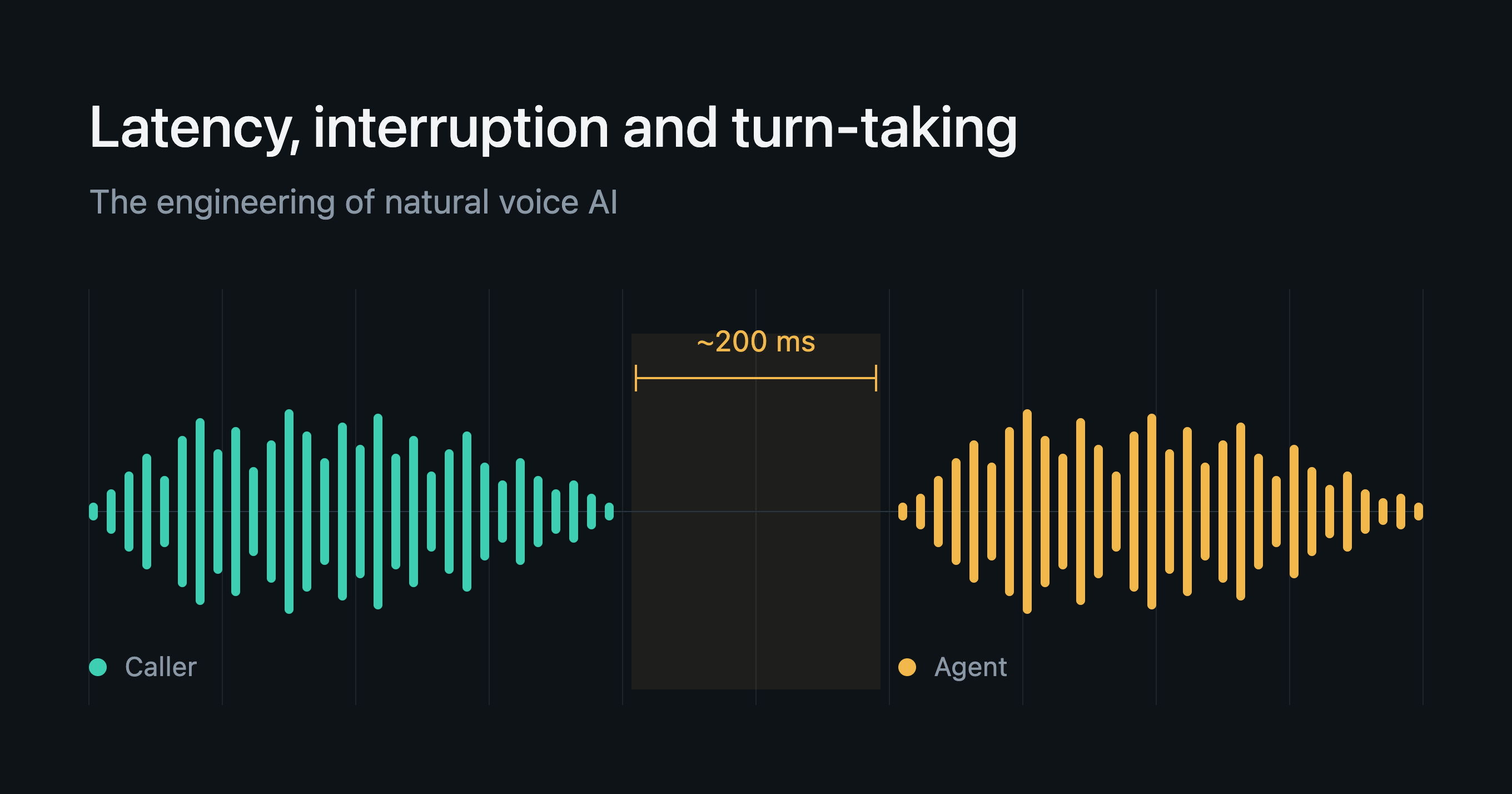
Speech recognition got accurate enough to handle accents, background noise and interruptions. Language models got good enough to hold a conversation without a rigid script. And the round trip latency, meaning the delay between a caller finishing a sentence and the agent starting to reply, dropped below the point where a human notices something is wrong.
That last one matters more than people expect. A delay of two seconds does not sound like much when you read it. On a phone call it is the difference between talking to something competent and talking to something broken. Human conversation has a turn taking rhythm of roughly two hundred milliseconds. Anything slower registers as hesitation, and callers start talking over the agent, which then causes the agent to lose the thread.
So the real story is not that AI got smarter. It is that the whole pipeline got fast enough to feel normal.
What can an AI voice agent actually do?
It helps to separate what these systems handle well from what they do not.
They handle well:
Answering every inbound call, including at two in the morning and during the lunch rush when your front desk is already on another line.
Qualifying a caller against criteria you define. Budget, timeline, location, service type, insurance provider, whatever your business uses to sort a good enquiry from a poor one.
Booking, rescheduling and cancelling appointments directly in your calendar or practice management system, with live availability rather than a promise to call back.
Capturing structured information and writing it into your CRM, so the record exists before anyone on your team touches it.
Making outbound follow up calls at scale. Appointment reminders, missed call callbacks, renewal notices, no show recovery.
They do not handle well:
Anything requiring judgement about a situation the system has no information about. Emotional conversations. Complaints that have already escalated once. Clinical or legal advice. Negotiation. Any call where being wrong is expensive and being slightly slower is not.
The useful framing is this. A voice agent is very good at the first ninety seconds of a call, which in most businesses is the part that is repetitive, high volume, and currently being done badly because the person answering is busy. It is not a replacement for the conversation that happens after that.
How does a voice agent work under the hood?
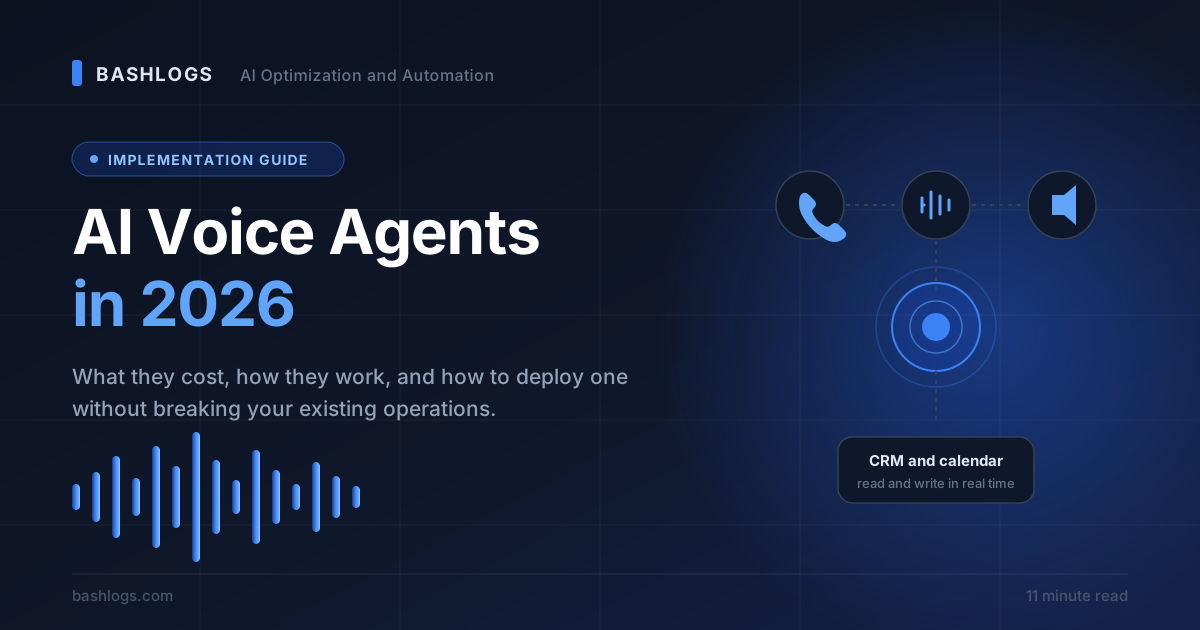
Most production systems are built from four layers stacked together. Knowing the layers is useful because when something goes wrong, it is almost always one specific layer, and knowing which one saves you a week.
Telephony. This connects the agent to the actual phone network. It handles the incoming number, call routing, recording and transfers. Twilio is the common choice, though voice platforms often bundle this.
Speech to text. This converts the caller audio into text in real time. The quality here determines almost everything downstream. If the transcription mishears a postcode or a surname, the rest of the system confidently acts on the wrong information.
The reasoning layer. This is the language model that decides what to say, what to ask next, and when to call a tool. This is where your business rules live. Not as a script, but as instructions and available actions.
Tool calls and integrations. This is where the agent stops talking and does something. Checking a calendar. Reading a customer record. Writing to a CRM. Sending a confirmation. Without this layer you have a chatbot on a phone line. With it you have something operationally useful.
Text to speech. This converts the reply back to audio. ElevenLabs and similar services handle this. Voice choice matters more than teams expect, because a voice that sounds slightly artificial makes callers less willing to give information.
Platforms like Vapi, Retell and Trillet package several of these layers together so you are not assembling everything yourself. That is usually the right call. The differentiation in a voice agent project is almost never in the plumbing. It is in the business rules and the integrations.
What does an AI voice agent cost?
Costs fall into two categories that get confused with each other constantly.
Build cost. A one time cost to design the conversation, connect your systems, define the escalation rules and test it under real conditions. For a straightforward inbound agent handling one use case, this typically starts around a few hundred dollars for a basic configuration and rises with the number of integrations and languages. Our own voice agent packages run from 250 dollars for a single inbound use case up to 850 dollars for a multi language, CRM integrated deployment with outbound capability.
Running cost. This is per minute and is charged by the underlying providers. It covers telephony, transcription, model usage and speech synthesis. In 2026 this typically lands somewhere between seven and twenty cents per minute depending on which models and voices you use. A practice taking four hundred calls a month averaging three minutes each is looking at roughly twelve hundred minutes, which is a running cost in the region of one hundred to two hundred and forty dollars monthly.
The comparison people usually want is against a human answering service, which tends to be priced per call or per minute at a considerably higher rate, or against a part time receptionist. The honest answer is that the economics are clearly favourable at high call volumes and much less clear at low ones. If you take fifteen calls a week, the operational benefit is real but the cost saving is not the reason to do it.
What is often the actual reason is missed calls. Most service businesses do not know their missed call rate. When they measure it, the number is usually between twenty and forty percent, and a meaningful share of those callers do not call back. That is the number worth calculating before anything else.
How do you deploy one without disrupting operations?
This is where most projects succeed or fail, and it has very little to do with the AI.
Start with one call type, not the whole phone line
The instinct is to point the main number at the agent and see what happens. This is the wrong first move. Pick the single highest volume, lowest risk call type you have. New patient enquiries. Booking requests. Delivery status checks. Route only that to the agent, either through an after hours line, an overflow line, or a menu option.
The reason is not caution for its own sake. It is that a narrow scope lets you actually evaluate the thing. When an agent handles every call type at once and something goes wrong, you have no idea whether the problem is the transcription, the business rules, or the integration.
Write the escalation rules before the conversation script
Decide, in writing, what causes the agent to stop and pass the call to a person. The list should be specific. Caller asks for a human. Caller mentions a clinical symptom on your escalation list. Caller becomes distressed. Agent fails to understand the same input twice. Value of the transaction exceeds a threshold.
Then decide what happens on handoff. Warm transfer to a ringing phone. Voicemail with a transcript. Slack message to a named person. A ticket in your system. An escalation path that dead ends is worse than no agent at all, because the caller has now spent ninety seconds and got nowhere.
Connect to real systems on day one
There is a strong temptation to launch with the agent taking down information and emailing it to someone. This feels like a safe intermediate step. In practice it recreates the exact problem you were trying to solve, which is a human retyping information into a system.
If the agent cannot read live availability, it cannot book. If it cannot write to the CRM, someone has to. Connect the systems during the build, not in phase two.
Test with recordings of real calls
Scripted testing tells you the happy path works. Real calls are not the happy path. People interrupt, give partial information, change their mind halfway through, put you on hold, have a child shouting in the background, and give their phone number in an unusual rhythm.
Take a set of recent recorded calls, if you have them, and run the agent against those scenarios. The failures you find this way are the ones that would otherwise show up in production.
Monitor the transcripts for the first month
Every call should be transcribed, logged, and reviewed. Not forever, but for the first four to six weeks. You are looking for a specific thing, which is the point in the conversation where callers get confused or drop off. That point is almost always one badly phrased question, and fixing it takes ten minutes.
What goes wrong in practice?
Five failure patterns account for most of the trouble we see.
The agent is too eager to keep talking. It tries to resolve situations it should have escalated. This is usually a prompt problem, and it is fixed by making the escalation conditions explicit rather than implied.
Numbers get transcribed wrong. Phone numbers, dates of birth, order references, postcodes. The fix is confirmation. Read the number back and ask the caller to confirm before acting on it. It costs four seconds and eliminates a category of error.
The integration fails silently. The agent tells the caller their appointment is booked, the write to the calendar fails, and nobody finds out until the person shows up. Every write action needs to be verified, and every failure needs to raise an alert to a human. This is basic engineering discipline and it is skipped constantly in AI projects because the demo worked.
Latency creeps up. Adding integrations adds round trips. Each one adds delay. A system that felt natural at launch feels sluggish three months later. Budget your latency the way you would budget page load time, and measure it.
Nobody owns it. The agent goes live, the project ends, and six months later the business has changed but the agent has not. It still quotes old pricing and offers a service you discontinued. Voice agents need an owner and a review schedule, the same as any other operational system.
Which industries see the strongest results?
The pattern is consistent. The businesses that benefit most have high inbound call volume, a repetitive first ninety seconds, and a real cost attached to a missed call.
Healthcare and dental practices. Front desks are busy with the patient in front of them while the phone rings. Intake is frequently typed twice, once on paper and once into the practice system. Voice agents handle intake and scheduling continuously and write directly into the practice system, with clinical escalation kept human.
Real estate. Enquiries arrive at unpredictable hours and go cold fast. An agent that qualifies budget, timeline and area before the agent calls back changes the economics of lead follow up.
Home services and trades. The person who could answer the phone is under a sink. Every missed call is a job that goes to whoever answered.
E-commerce and logistics. Order status and delivery exception calls are high volume, highly repetitive, and require a system lookup that an agent can do faster than a person.
Professional services. Intake qualification, scheduling and document chasing are all structured enough to automate and are all currently being done by someone whose time is worth more.
Where to start
If you are evaluating this seriously, the first step is not choosing a platform. It is measuring three numbers.
How many inbound calls do you receive per month. What percentage go unanswered. What is a converted enquiry worth to you.
Those three numbers will tell you whether this is a cost saving project, a revenue recovery project, or neither. In our experience it is usually the second, and the number is larger than expected.
If you want to work through those numbers against your own operation, or you want to see a voice agent handling a call type specific to your business, get in touch and we will put something concrete in front of you.
Frequently asked questions
Can a caller tell they are speaking to an AI? Often yes, and it is generally better to disclose it early. Callers who are told upfront tend to be more cooperative than callers who work it out halfway through and feel misled. Some jurisdictions require disclosure.
What happens if the agent does not understand? It should ask once for clarification, then escalate. An agent that asks the same question three times is a worse experience than a hold queue.
Can it handle more than one language? Yes. Multi language handling is standard in current platforms, though each additional language needs its own testing pass. Accuracy varies by language and by accent within a language.
Will it work with our existing phone system? In most cases yes. The agent can sit on a dedicated number, an overflow route, an after hours route, or a menu option. Replacing the main line is possible but is rarely the right first step.
How long does implementation take? A single narrow use case with straightforward integrations is typically a matter of days to a couple of weeks. Complexity comes from the number of systems being connected and the number of edge cases in the business rules, not from the AI itself.
Is our call data secure? It depends on the providers in the stack and how the system is configured. In regulated sectors this needs to be specified before the build starts, including where recordings are stored, how long they are retained, and which providers process the audio.