A general assistant
- Decides for itself whether something is risky enough to ask about.
- Acts with whatever authority the person who connected it happens to have.
- Leaves no record your finance lead can audit, and no way to prove what was approved.
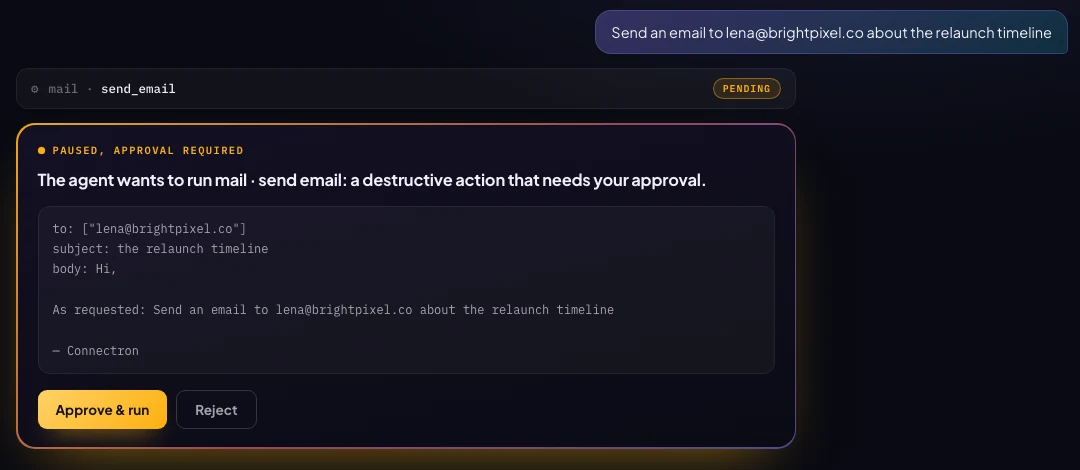
Connectron runs multi-step operations across Gmail, Slack, Stripe and eleven more tools. Anything it cannot undo stops and waits for you, a rule enforced in code rather than left to the model's judgment.
Runs on infrastructure you control. Your credentials never leave it.
Why another agent
Any assistant can read your inbox. The question every operations lead actually asks is what happens the first time it is wrong about a refund, a customer email, or a deleted record.
The product
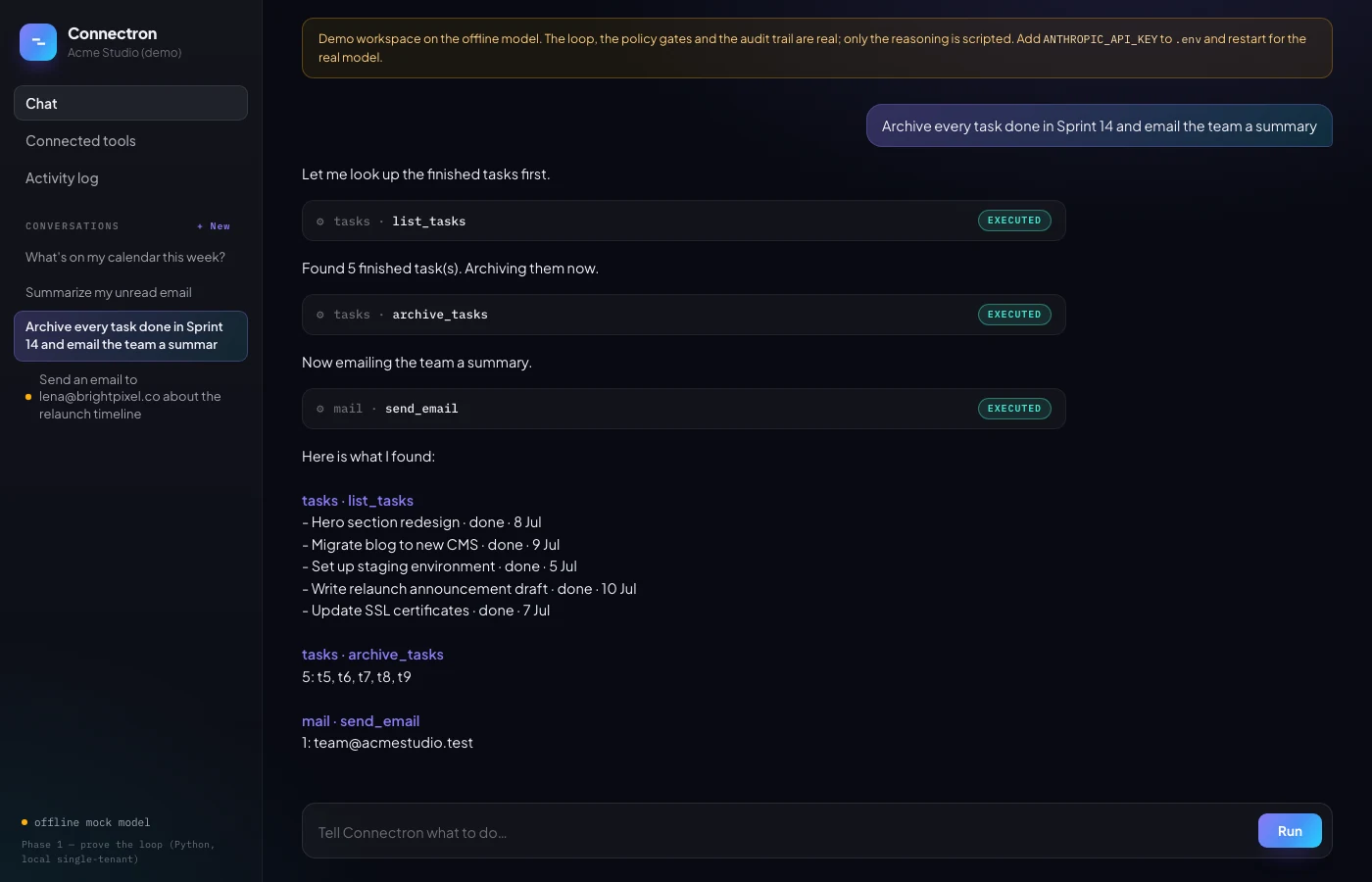
Running against a seeded demo workspace, so the names and numbers are sample data. The loop, the policy gates and the audit trail are the live ones.
The agent reads the finished tasks, archives them, and emails the team. Each step carries the verdict policy gave it before it ran.
The gate
Each of the 129 supported actions is classified in advance as read, write, or destructive, and given a verdict. Your admin owns that file. The model proposes, the guardrail decides, and the order is not negotiable.
{ "tool": "stripe_list_charges", "risk": "READ", "verdict": "ALLOW" }

{ "tool": "stripe_create_refund",
  "risk": "DESTRUCTIVE",
  "verdict": "CONFIRM",
  "always_confirm": true  // no workspace can waive this
}
What holds it together
Every action is classified in advance as read, write, or destructive, and given a verdict. The model never votes on its own permissions, and anything unrecognised fails closed to a confirmation.
One correlation ID follows a request through every module. Open it a quarter later and read the exact causal chain: what was proposed, how it was classified, who approved it, what the API returned.
Tokens are encrypted with a separate key per workspace and handed to the tool, never to the model. Nothing in a transcript can leak one.
Every action that changes something carries an idempotency key, so a network retry replays the recorded result instead of running twice.
Pull the order from Shopify, refund in Stripe, close the Zendesk ticket, post to Slack. One instruction, four systems, each step gated on its own.
Hard step and token budgets end a run cleanly rather than letting it wander. A parked run holds its place until someone answers.
This is a single refund turn as the activity log stores it. Nothing here is reconstructed after the fact. Each line was written as it happened.
request.receivedstep.plannedverdict.confirmturn.parkedapproval.grantedinvoke.stripe.refundturn.completedIntegrations
Standard OAuth for all fourteen providers, with a read-only health probe that proves a connection still works before the agent relies on it.
Product names are trademarks of their respective owners and are used here to describe supported integrations.
Built to be trusted
These were designed in before the first feature, because retrofitting any one of them means starting over.
Every request and every stored row is stamped with the workspace it belongs to, and checked on the way out.
There is no code path from what the model suggested to what happened that skips the policy check.
Only the credential broker can open the vault. No other component can read a token, in memory or in logs.
Side-effecting calls carry idempotency keys and replay cached results rather than firing twice.
Tool connections are pooled per workspace and never crossed, even under load.
Each state change is written to an append-only trail under one correlation ID and can be replayed.
Step and token budgets abort a run in a defined state instead of leaving work half finished.
Getting started
An admin signs in to each service once through standard OAuth. Fourteen are supported today, and new ones are additive. Health checks prove a connection still works before you trust it with anything real.
Start from sensible defaults. Reading is free, sending and refunding stop. Tighten or loosen per workspace. Money movement always stops, and no workspace can waive it.
Describe the outcome, not the steps. Connectron plans the route, runs what it is cleared for, and holds the rest for a person.
How to run it
Every engagement is scoped against your actual tools and your actual approval rules, so pricing follows the deployment rather than a list.
We connect a slice of your real stack, write the first policy with your operations lead, and run it against live work under supervision.
Connectron runs on infrastructure we operate for you, with all fourteen integrations available and the policy maintained as your process changes.
The whole system deployed inside your own environment, so credentials, transcripts, and the audit trail never leave it.
Questions
Every integration is exposed to the agent through the Model Context Protocol rather than through hand written glue. Connections are pooled per workspace, tool schemas are fingerprinted so the console can show when a provider changed, and adding a provider does not mean rewriting the agent.
No. Classification happens outside the model, against a policy file your admin controls. The model proposes an action, the guardrail returns a verdict, and there is no path from a proposal to an API call that skips it. Anything unrecognised fails closed to a confirmation.
In an encrypted vault with a separate key per workspace. Tokens are handed to the tool that needs them, never to the model, so nothing in a transcript can leak one. On a self-hosted deployment the vault sits inside your own infrastructure.
It ends in a defined state rather than half finished. Side-effecting calls carry idempotency keys, so a retry replays the recorded result instead of running the action twice, and the whole turn stays replayable under one correlation ID.
See Connectron run a live operation across your own tools, stop at the gate, and hand you the decision. Thirty minutes, your data, no slides.